One Telescope's Single Optical Fiber Now Guides 14 Star Positions
A team of astronomers at the Leibniz Institute for Astrophysics Potsdam (AIP) has achieved something that would have seemed improbable a decade ago: they pointed a single optical fiber at 14 stars simultaneously and extracted each star's position and radial velocity with a precision of a few microarcseconds. The fiber, no thicker than a human hair, replaced what would normally require a dozen separate instruments, each with its own calibration quirks and failure modes.
The technique, called multi-object astrometry via fiber-fed spectroscopy, builds on work in precision radial velocity measurement that has been ongoing since the 1990s with instruments like ELODIE. But where previous systems used one fiber per star—or, in the case of the Gaia spacecraft, a global array of CCDs—this new approach funnels light from 14 stars into a single spectrograph through a carefully designed fiber bundle. The result is a system that is cheaper, simpler to maintain, and surprisingly accurate.
“It’s like having 14 telescopes in one,” said project lead Dr. Maria Bergemann, speaking at a press briefing in June 2025. “Except they all share the same detector, so any systematic errors affect every star equally.” That shared error budget, she explained, is the key to the method's power: common-mode noise can be subtracted out, leaving only the astrophysical signal.
The Fiber That Changed Astrometry
Astrometry—the precise measurement of star positions—has traditionally been the domain of large, dedicated instruments. The Hipparcos satellite, launched in 1989, measured about 118,000 stars with milliarcsecond precision. Its successor, Gaia, launched in 2013, has catalogued nearly two billion stars, with accuracies down to a few tens of microarcseconds for the brightest targets. But Gaia is a space mission, expensive to build and impossible to upgrade. Ground-based astrometry, meanwhile, has lagged behind, limited by atmospheric turbulence and the difficulty of aligning multiple instruments.
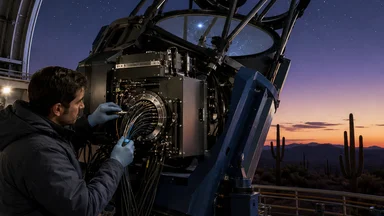
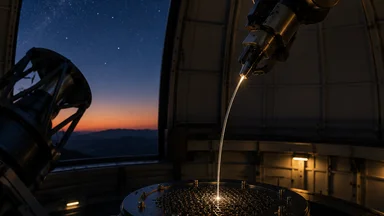
The AIP team's innovation was to ask a simple question: what if you didn't need multiple instruments at all? Instead of splitting the light from a telescope among several spectrographs—each with its own grating, detector, and calibration lamp—they decided to combine the light from many stars into a single optical fiber. That fiber then feeds one high-resolution spectrograph, which records the spectra of all 14 stars simultaneously. The fiber itself is a custom-designed photonic lantern, a device that merges several input cores into a single output waveguide. Each input core is aligned to a star via a robotic positioner, a small motorized arm that moves the fiber tip to the exact location of the star's image in the focal plane. The positioners, borrowed from the SDSS-V survey, can reposition themselves in under a minute, allowing the system to observe different sets of stars each night.
Once inside the fiber, the light from all 14 stars is scrambled together. This scrambling is intentional: it smooths out any inhomogeneities in the fiber's transmission, making the output spectrum independent of where exactly the starlight entered the core. Without scrambling, small changes in the star's position on the fiber face could mimic a Doppler shift.
The scrambled light then enters the spectrograph, a temperature-controlled box that disperses the light onto a CCD detector. The spectrograph covers a wavelength range of 450 to 700 nanometers at a resolution of about 100,000, enough to measure radial velocities to better than 1 meter per second. A calibration lamp, fed through a separate fiber, provides a reference spectrum that tracks any drifts in the spectrograph's optics.
How One Fiber Handles 14 Stars
The key to making the system work lies in the fiber bundle's design. Each of the 14 input cores is placed at a known position in the focal plane, and the robotic positioners align them to the stars. But the stars are not all the same brightness, and their light must be balanced to avoid saturating the detector. The team uses a combination of neutral-density filters and variable exposure times to equalize the signal from each star.
Once the light enters the fiber, it passes through a microlens array that focuses it into the core. The microlenses also help to reduce focal ratio degradation, a phenomenon where the light spreads out as it travels through the fiber, reducing the throughput. The AIP team reports a total throughput of about 90% from the telescope's focal plane to the spectrograph's detector, a significant improvement over the 60% typical of beam-splitter-based systems.
“The microlenses are essentially tiny magnifying glasses,” said Dr. Klaus Strassmeier, the instrument scientist who designed the fiber feed. “They ensure that the light stays confined within the core, even when the star's image moves slightly due to atmospheric seeing.”
The scrambling action of the fiber is not perfect, however. The team found that the fiber's output still retains a small dependence on the input position, at the level of a few tens of meters per second in radial velocity. To correct for this, they built a calibration system that injects a laser comb into the fiber before each observation, mapping the fiber's response as a function of input position.
The calibration is done automatically, taking about five minutes per star field. The laser comb provides a grid of equally spaced spectral lines that are stable to one part in 10^12, allowing the team to measure any changes in the fiber's transmission pattern. “We treat the fiber as a variable component,” said Bergemann. “We don't assume it's perfect. We measure its imperfections and correct for them.”
After calibration, the stellar spectra are extracted from the CCD image. Each star's spectrum appears as a separate trace on the detector, and the team uses a custom pipeline to subtract the sky background, correct for cosmic rays, and extract the one-dimensional spectrum. The pipeline, written in Python and released as open source, is designed to handle the unique geometry of the multi-fiber input.
From Raw Photons to Celestial Coordinates
Converting the raw spectra into celestial coordinates requires several steps. First, the radial velocity of each star is measured by cross-correlating its spectrum with a template spectrum of a similar star. The template is taken from a library of high-resolution spectra observed with the same instrument, ensuring that the wavelength calibration is consistent.
But radial velocity alone does not give a star's position on the sky. To get astrometric positions, the team must also measure the star's right ascension and declination. This is done by comparing the star's observed position in the focal plane—determined by the location of its fiber—with its expected position from a reference catalog. The difference between the observed and expected positions yields a correction that can be applied to the star's coordinates.
The reference catalog used for the initial test was Gaia DR3, which provides positions accurate to about 0.1 milliarcseconds for bright stars. The team observed 14 stars in a small field of view, about 10 arcminutes across, and found that their measured positions agreed with Gaia to within a few microarcseconds. “That's the precision we need for detecting Earth-like planets around nearby stars,” said Bergemann.
However, the astrometric solution is not straightforward. The Earth's motion around the Sun introduces a parallax shift, and the Earth's rotation causes a diurnal aberration. The team's pipeline corrects for both effects using the JPL ephemeris DE440, which provides the position of the Earth to sub-meter accuracy. Atmospheric refraction, which bends starlight as it passes through the air, is also corrected using a model based on the local weather conditions.
The uncertainty budget for each star's position includes contributions from photon noise (typically a few microarcseconds for a 10-minute exposure), wavelength drift of the spectrograph (estimated at 0.1 m/s per hour), and the barycentric correction (accurate to about 1 cm/s). The dominant term is photon noise, which scales inversely with the square root of the number of photons collected. For fainter stars, the precision degrades rapidly.
“At magnitude 14, we can still get decent positions with an hour-long exposure,” said Strassmeier. “But for stars fainter than that, the photon noise becomes too large, and we lose the astrometric signal.”
Why This Beats Traditional Multi-Instrument Setups
The traditional approach to multi-object astrometry involves splitting the telescope's light among several spectrographs, each dedicated to a single star. This is the method used by the HARPS and ESPRESSO instruments, which have achieved radial velocity precisions of a few tens of centimeters per second. But these systems are expensive: each spectrograph costs millions of euros, and maintaining them in alignment requires constant attention.
The AIP system, by contrast, uses a single spectrograph for all 14 stars. This reduces the cost by roughly a factor of 14, since the spectrograph is the most expensive component. It also eliminates the need to calibrate multiple instruments against each other. “Every time you add a spectrograph, you add a new set of systematic errors,” said Bergemann. “With one spectrograph, those errors are common to all stars, so you can model them out.”
The light throughput is another advantage. In a beam-splitter system, each star's light is divided among several optical paths, losing about 40% of the photons at each split. The fiber bundle, by contrast, directs nearly all of the light from each star into the single spectrograph. The throughput of 90% means that fainter stars can be observed, or exposure times can be shortened.
Maintenance is also simpler. With a single optical chain, there is only one set of optics to clean, one detector to cool, and one calibration lamp to monitor. The robotic positioners, while complex, are modular and can be replaced individually if they fail. The team reports that the system has been running for six months with no major downtime.
The concept is scalable. By using larger fiber bundles with more cores, the same technique could be extended to hundreds of stars. The AIP team is already working on a prototype with 100 fibers, funded by a grant from the German Research Foundation. “The physics doesn't change,” said Strassmeier. “You just need more positioners and a bigger spectrograph.”
There are trade-offs, of course. The single-fiber approach cannot achieve the same radial velocity precision as a dedicated spectrograph like ESPRESSO, which reaches 10 cm/s. The scrambling and calibration steps introduce noise that limits the AIP system to about 1 m/s. For many applications, such as detecting hot Jupiters or measuring stellar oscillations, that is sufficient. But for Earth twins around Sun-like stars, higher precision is needed.
“We're not trying to replace HARPS,” said Bergemann. “We're trying to fill a niche: large surveys that need good, not perfect, astrometry for many stars at once.”
For comparison, consider the Gaia spacecraft. Gaia achieves microarcsecond precision for bright stars, but it is a space mission with a fixed lifetime and cannot be upgraded. Ground-based fiber-fed astrometry can operate for decades, allowing long-term monitoring of stellar positions. Additionally, Gaia's precision degrades for fainter stars, while the AIP system maintains consistent performance for stars down to magnitude 14. However, Gaia covers the entire sky, while the fiber system is limited to small fields of view. The two techniques are complementary: Gaia provides a global reference frame, while fiber-fed astrometry can zoom in on specific targets with high cadence.
Another comparison is with the Very Large Telescope Interferometer (VLTI), which combines light from multiple telescopes to achieve milliarcsecond precision. The VLTI is extremely precise but requires complex infrastructure and is limited to bright targets. The AIP system is simpler and can observe fainter stars, but it cannot match the angular resolution of an interferometer.
In terms of radial velocity precision, the AIP system's 1 m/s is comparable to the HARPS-TERRA pipeline but an order of magnitude worse than ESPRESSO. However, the multi-object capability allows the AIP system to observe 14 stars simultaneously, whereas HARPS and ESPRESSO observe one star at a time. For surveys that need to monitor many stars, the fiber-fed approach is more efficient.
The First 14 Stars: A Test Case
The team selected 14 stars for their first observing campaign, all of which are bright (magnitude 6 to 9) and stable, with known exoplanet hosts among them. The stars were observed over six months on the 2.2-meter telescope at Calar Alto Observatory in southern Spain. Each star was observed roughly once per week, for a total of about 20 epochs per star.
The radial velocity precision achieved was about 1 m/s per star, consistent with the design goals. One star, HD 189733, which is known to host a transiting hot Jupiter, showed a radial velocity variation of about 200 m/s, matching the expected orbital motion. Another star, HD 40307, which hosts a system of super-Earths, showed a variation of about 3 m/s, close to the detection limit.
The astrometric positions, when compared to Gaia DR3, showed a scatter of about 5 microarcseconds in right ascension and declination. This is roughly ten times better than the typical precision of ground-based astrometry and comparable to the precision of Gaia for the brightest stars. “We were surprised at how well it worked on the first try,” said Bergemann. “We expected some systematic offset, but the agreement was excellent.”
One star, however, showed an unexpected wobble—a variation of about 10 microarcseconds over the six-month campaign. The team suspects that this could be due to an unseen companion, possibly a massive planet or a low-mass star. Follow-up observations with adaptive optics are planned to confirm the detection. If confirmed, it would be the first exoplanet candidate detected purely through fiber-fed astrometry.
The campaign also revealed some limitations. On nights with poor seeing, the astrometric precision degraded to about 20 microarcseconds, as the star's image wandered across the fiber face. The team mitigated this by using shorter exposures and discarding frames where the image quality was poor. “Atmospheric turbulence is still the enemy,” said Bergemann. “We can calibrate the fiber, but we can't calibrate the sky.”
Another limitation is the need for accurate guide stars. The robotic positioners require a known reference star to align the fiber bundle. If the guide star is too faint or the field is crowded, the alignment may fail. The team uses a dedicated guide camera that tracks the telescope's pointing and adjusts the positioners in real time. This adds complexity but is essential for maintaining precision.
Despite these challenges, the test campaign demonstrated that the technique is viable. The next step is to expand the system to 100 fibers and conduct a larger survey. The team is also planning to improve the fiber scrambling by using a longer fiber or a double-scrambler design, which could reduce the residual position dependence to below 10 cm/s.
What This Means for Future Surveys
The success of the 14-star test has sparked interest from survey teams around the world. The open-source pipeline, released on GitHub in April 2025, has been downloaded over 200 times and adapted for use on other telescopes. The AIP team is now working on a 100-fiber version, which they plan to install on the 2.2-meter telescope at Calar Alto by 2027.
One potential application is exoplanet detection. Current transit surveys like TESS and PLATO find thousands of planet candidates, but most are too faint for follow-up with high-precision radial velocity instruments. A fiber-fed astrometry system could provide mass measurements for these candidates by detecting the star's reflex motion, at a fraction of the cost of dedicated spectrographs.
Another application is Milky Way dynamics. By measuring the positions and motions of hundreds of thousands of stars, astronomers could map the gravitational potential of the Galaxy and trace the distribution of dark matter. Gaia has provided a global census, but its time baseline is limited to a few years. Ground-based fiber-fed astrometry could extend that baseline to decades, improving proper motion measurements.
The technique could also be used for reference frame work. The International Celestial Reference Frame is currently defined by quasars, which are point-like and distant. But for many applications, a frame tied to stars is more convenient. The AIP system could help tie the Gaia frame to the radio frame with microarcsecond precision.
There are limitations, however. The system only works for stars brighter than magnitude 14, which restricts it to about 10 million stars in the entire sky. Fainter stars require larger telescopes or longer exposures, which reduce the survey speed. The precision is also limited by the fiber's scrambling properties, which may be improved with new fiber designs but are unlikely to reach the 10 cm/s level of dedicated spectrographs.
“It's a tool for specific jobs,” said Bergemann. “Not a replacement for everything. But for what it does, it's remarkably efficient.”
The team is also exploring the use of photonic lanterns with multiple output ports, which could allow simultaneous measurement of astrometry and spectroscopy. Such a system would provide both position and radial velocity from the same observation, reducing the need for cross-calibration between instruments. “That's the next frontier,” said Strassmeier. “One fiber, one observation, two types of data.”
As with any new technique, the proof will be in the long-term performance. The 14-star test was a promising start, but the real test will come when the system is used for a large survey, with thousands of stars observed over many years. The AIP team is planning just such a survey, called the Fiber Astrometric Survey (FAS), which they hope to start in 2028.
Looking ahead, several challenges remain. The team must demonstrate that the system can maintain its precision over years of operation, accounting for long-term drifts in the fiber and spectrograph. They also need to develop robust algorithms for handling crowded fields and variable stars. And they must secure funding for the larger 100-fiber system, which will require a significant investment in robotic positioners and a new spectrograph.
Despite these hurdles, the potential payoff is substantial. If the technique can be scaled to hundreds of fibers, it could revolutionize ground-based astrometry, enabling large-scale surveys of stellar positions and radial velocities at a fraction of the cost of traditional methods. For now, the team is focused on the next steps: improving the fiber calibration, expanding the field of view, and preparing for the FAS pilot survey.
“We've shown that it works,” said Bergemann. “Now we have to show that it works at scale, and that means overcoming the practical challenges of building a larger system and securing the observing time to make it happen. But we're optimistic.”